
Property types
Commercial Land
The parcel that looks best on a map is frequently the one that cannot be built. We check in the order that matters.
Home/Property Types/Commercial Land & Development Sites
TL;DR
Commercial land in North Georgia is evaluated on buildable area rather than gross acreage. Slope, rock, floodplain, stream buffers and wetlands reduce the developable footprint, while sewer availability and treatment capacity, water and power service, and access permissions determine what a site can actually support.
Overview
Buildable, not gross.
We approach land the way a civil engineer does rather than the way a listing sheet does: start with what physically and legally constrains the site, and let price follow from what is left.
That sequence disqualifies parcels early, which feels unhelpful and is actually the value. A due diligence period spent discovering that sewer capacity is unavailable is a due diligence period that cost you the option period on a site that would have worked.
It also occasionally works the other way. A parcel that looks compromised can be the right buy when the constraint sits on the portion you were never going to build on.
The constraint stack
Why acreage is the least useful number.
A North Georgia land listing leads with acres and price per acre. Both are nearly useless on their own, because the question that decides value is how much of that acreage can carry a building and a parking field.
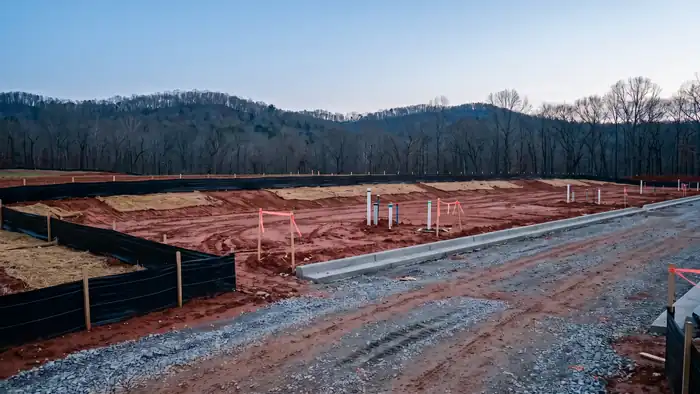
Slope is the first subtraction. In the foothills, grading cost rises sharply with terrain, and beyond a certain gradient a site stops being economically buildable regardless of what the zoning permits. Rock makes this worse and is expensive to discover late.
Then the water features. Stream buffers, floodplain and wetlands are regulated, they are not always mapped accurately, and they remove area from the developable footprint before any design work begins.
Then infrastructure. Public sewer availability (and separately, whether the treatment plant has capacity to allocate) governs density far more than the zoning map does. A septic-limited commercial parcel has a much shorter list of viable uses than its district suggests.
Only after all of that does zoning and permitted use become the interesting question. Most land deals go wrong because that order gets reversed.
Questions
What operators and owners ask.
How do I confirm sewer availability?
In writing from the utility provider, covering two separate questions: whether a line reaches the property, and whether the treatment plant has capacity to allocate to your project. A line at the road is not capacity.
What does a stream buffer do to a site?
Georgia regulates undisturbed buffers along state waters, with local jurisdictions sometimes imposing wider ones. The buffer removes area from development and can sever an otherwise usable parcel. Confirm the applicable width with the local jurisdiction and the state.
Should I buy land subject to rezoning?
If you buy contingent on it, yes, with a contract that keeps your money at risk only after the outcome is known. Rezoning is discretionary and political, and no broker, attorney or planner can guarantee it.
Is a perc test enough for a commercial septic system?
A residential-style perc test is not the same as a commercial septic design. Commercial flows are larger and use-dependent, and the county environmental health office sets the requirements. Get the actual commercial evaluation for your intended use.
Our residential division
Land for a home instead?
Homesites, acreage for a personal residence and mountain lots are handled by the residential division.
Gold Peach Commercial
Start with what can’t change.
Topography, water features and utilities. Price is the easy part and it comes last.