
Property types
Retail Space
Historic squares, highway frontage and outparcels: three different businesses wearing the same category name.
Home/Property Types/Retail Space
TL;DR
Retail space in North Georgia falls into three broad groups: walkable historic downtown storefronts in Dahlonega, Blue Ridge and Ellijay; highway-frontage and outparcel positions on GA-400, GA-515 and GA-365; and neighbourhood centres serving residential growth in Forsyth, Hall and North Fulton counties.
Overview
Three markets, one label.
Where a retail space sits determines almost everything about how it performs. Downtown storefronts trade on foot traffic, character and proximity to other destinations. Highway sites trade on access geometry and traffic composition. Neighbourhood centres trade on rooftops within a short drive.
The tourism counties add seasonality that a metro operator will underestimate. In Fannin, Gilmer and White counties, visitor flow varies substantially through the year, and a lease signed on the strength of an October weekend needs to survive a February one.
We work all three groups and will tell you plainly which one a given space belongs to (including when a highway building is being marketed as if it had downtown characteristics.
What decides retail here
Access beats visibility.
Retail brokers everywhere talk about visibility. In North Georgia the more binding constraint is usually access: specifically, whether a customer travelling in the direction your customers travel can actually turn into the site.
A median with no break, a curb cut too close to an intersection, or a left turn across highway traffic at speed will suppress a site that looks excellent from the road. On the state routes this is governed by the Georgia Department of Transportation rather than the county, and permission is not automatic.
The second factor is traffic composition. GA-400 through Dawsonville and GA-515 through Ellijay carry heavy weekend leisure traffic and lighter weekday local traffic. A concept dependent on weekday lunch will read those counts optimistically. A concept serving weekend visitors will read them correctly.
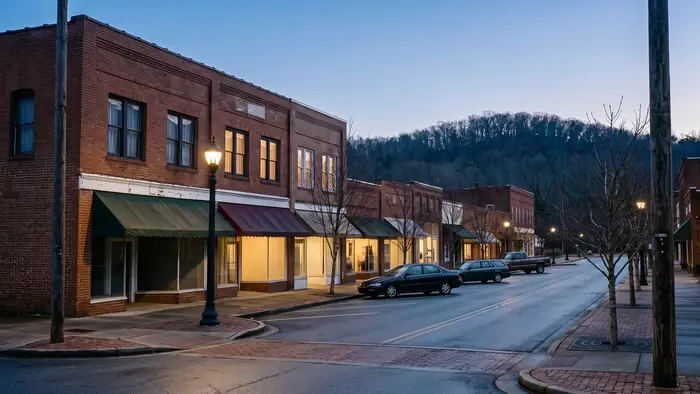
Third: downtown versus corridor. The historic squares in Dahlonega, Blue Ridge and Ellijay generate genuine pedestrian traffic that no highway outparcel replicates (with smaller floorplates, older buildings, limited parking and seasonality attached.
Questions
What operators and owners ask.
What is second-generation retail space?
Space previously fitted out for a similar use, so some infrastructure remains) often grease traps, hoods, walk-in coolers or existing plumbing. It can save substantial build-out cost, but verify that what is there is serviceable and still meets current code.
Do I need a percentage rent clause?
Percentage rent is more common in anchored centres than in the single-tenant and small-strip space that dominates this region. Where it is proposed, the breakpoint and the definition of gross sales matter more than the percentage.
How seasonal is retail in the mountain counties?
Meaningfully seasonal in the tourism markets. We will not put a figure on it because we do not hold licensed data to support one. What we will do is tell you which corridors are visitor-dependent and which are supported by year-round local demand.
Can I get a drive-through?
It depends on the zoning district and often requires a special use permit, plus a site plan that satisfies stacking depth and access requirements. On a state route the curb cut is a Georgia DOT question. Establish this before signing anything, because it frequently cannot be added later.
Our residential division
Living where you open
Retail operators moving into a new North Georgia market often relocate too. The residential division handles the home search.
Gold Peach Commercial
Where you land decides the rest.
Tell us the concept and the customer. The right corridor narrows fast.